
.jpeg)

AI Native OS
Built In Austin Texas
Built In Austin Texas


Stop designing workflows around human constraints.
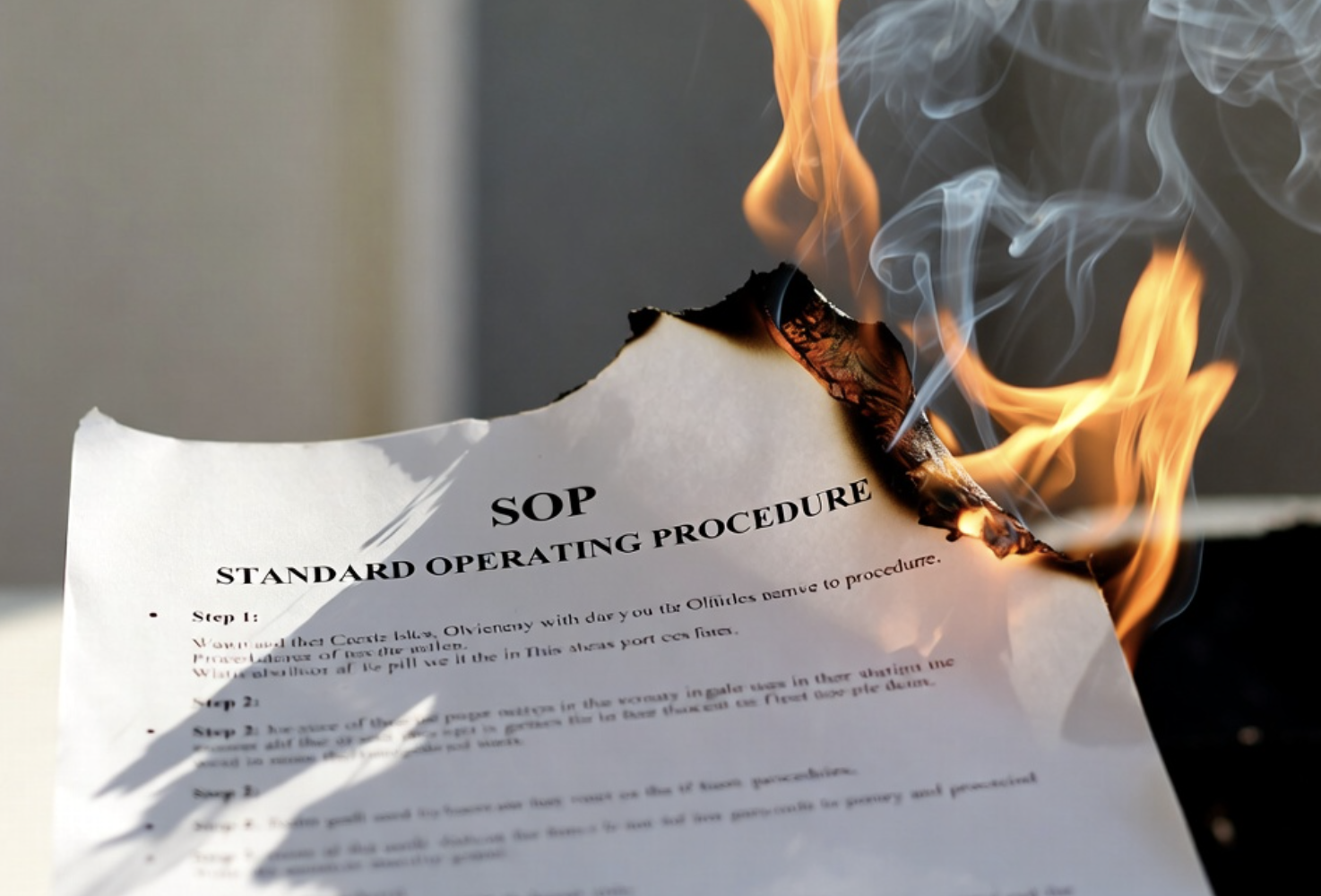
Every company has SOPs.
Standard Operating Procedures that tell employees exactly how to handle customer inquiries, process orders, manage returns.
They're all designed wrong.
Not because they're bad procedures. Because they're designed around human limitations.
And when you replace humans with AI employees, those limitations disappear.
Which means your SOPs need to be completely redesigned.
Human SOPs optimize for the wrong things:
Speed over satisfaction - Because humans get tired, SOPs minimize handle time
Consistency through restriction - Because humans vary, SOPs limit choices to reduce errors
Efficiency over experience - Because labor costs scale linearly, SOPs eliminate "unnecessary" steps
One-size-fits-all - Because you can't test what works, SOPs use best guesses
All of this made sense when humans did the work.
Now it's just leaving money on the table.
AI employees don't have the limitations humans do:
They don't get tired - So you can optimize for customer satisfaction instead of handle time
They execute identically - So you can actually A/B test workflows and measure what works
They don't cost more for extra steps - So you can add courtesy and personalization that humans skip
They scale without fatigue - So customer service can become a revenue center, not a cost center
Your workflows should reflect this.
Old SOP (designed for humans):
Step 5: Resolve the customer's issue
Step 6: Close the ticket
Why: Adding "say thank you" is an extra step. Humans forget it when busy. It slows down handle time. Not worth the effort.
New SOP (designed for AI):
Step 5: Resolve the customer's issue
Step 6: If customer expressed gratitude, respond with personalized thanks
Step 7: Close the ticket
Why: AI employees execute this perfectly every time. Doesn't slow them down. Customers notice and appreciate it. Costs you nothing.
The result: Better customer experience with zero additional effort.
You optimized for human constraints that don't exist anymore.
Old SOP (designed for humans):
Step 3: Provide order status
Step 4: Ask if there's anything else you can help with
Step 5: Close ticket
Why: You can't test if mentioning a related product works. Every rep does it differently. Some mention it, some don't. You have no data on what converts.
New SOP (designed for AI):
VARIANT A:
Step 3: Provide order status
Step 4: Mention complementary product if order total < $100
Step 5: Close ticket

VARIANT B:
Step 3: Provide order status
Step 4: Ask if there's anything else you can help with
Step 5: Close ticket
Run A/B test: 50% of tickets get Variant A, 50% get Variant B
Measure: Which variant generates more follow-up purchases?
The AI executes both variants identically. You get clean data.
After two weeks you know:
You just turned customer service into a revenue center.
With humans, you could never test this systematically.
Old SOP (designed for humans):
Step 1: Identify issue
Step 2: Provide solution
Step 3: Close ticket
Target: Under 5 minutes average handle time
Why: Humans handling 50 tickets a day get exhausted. Minimize handle time to keep them productive.
New SOP (designed for AI):
Step 1: Identify issue
Step 2: Check for related issues (previous tickets, account problems)
Step 3: Provide comprehensive solution addressing root cause
Step 4: Verify customer understands resolution
Step 5: Close ticket
Target: First contact resolution rate >90%
Why: AI employees don't get tired. Optimize for solving the problem right the first time, not solving it fast.
The result:
You were optimizing for human endurance. AI doesn't have that constraint.
Here's what changes when you can A/B test workflows:
You can test:
With humans: Every rep does it differently. You have no idea what actually works.
With AI: Split traffic 50/50, execute identically, measure results.
After 1,000 tickets you know:
You're not guessing anymore. You're measuring.
Traditional approach:Customer service is a cost center. Minimize cost per interaction.
AI employee approach:Customer service is a revenue opportunity. Maximize value per interaction.
Test This Workflow:
Customer: "Where's my order?"

AI Response (Variant A - Control):
"Your order #12345 shipped yesterday via USPS.
Expected delivery: February 10th.
Tracking: [link]
Anything else I can help with?"

AI Response (Variant B - Revenue Test):
"Your order #12345 shipped yesterday via USPS.
Expected delivery: February 10th.
Tracking: [link]

Since you ordered [Product A], many customers also add [Product B]
which complements it perfectly. Would you like me to add that to
your next order with free shipping?"
Run this for two weeks. Measure:
Actual results from a Cerebral customer:
You can't do this with human reps.
They forget to mention it. They mention different products. They do it inconsistently.
With AI, it happens the same way every single time.
Stop designing workflows around human constraints:
Old thinking: Minimize steps (humans get tired)
New thinking: Maximize value (AI doesn't get tired)
Old thinking: One standard response (consistency through restriction)
New thinking: A/B test variations (consistency enables testing)
Old thinking: Speed metrics (minimize handle time)
New thinking: Outcome metrics (maximize first-contact resolution)
Old thinking: Reduce complexity (humans make mistakes)
New thinking: Add sophistication (AI executes perfectly)
Old thinking: Customer service as cost center (labor scales linearly)
New thinking: Customer service as revenue center (AI scales without additional cost)
Human-centric workflow design:
Goal: Minimize effort
Constraint: Human fatigue and variance
Result: Simple, restrictive, one-size-fits-all
AI-centric workflow design:
Goal: Maximize customer satisfaction and revenue
Constraint: None (AI doesn't get tired or vary)
Result: Complex, testable, optimized through data
This is a fundamental shift.
Not "make the AI do what humans did."
"Redesign the workflow around what AI can do that humans couldn't."
1. Courtesy vs Efficiency
2. Upsells in Support
3. Proactive vs Reactive
4. Explanation Depth
5. Follow-up Timing
Run each test for two weeks.
Measure everything.
Keep what works.
You couldn't do this with humans. Now you can.
Traditional customer service:
AI-powered customer service:
Same customer interactions. Completely different economics.
Example math:
Old model (human reps):
New model (AI employees):
$31,000/month swing.
Just by redesigning workflows to leverage AI capabilities.
This isn't about removing humans.
It's about redesigning workflows so humans supervise and AI executes.
Humans:
AI Employees:
The workflow looks like:
Step 1: AI identifies customer issue
Step 2: AI proposes solution
Step 3: If refund >$500 → human approval required
Step 4: AI executes approved solution
Step 5: AI follows up with customer
Step 6: AI logs interaction for analysis
Humans make judgment calls. AI executes flawlessly.
They take their existing SOPs and just "give them to the AI."
That's like taking a horse-drawn carriage manual and using it to operate a car.
Same transportation goal. Completely different mechanics.
Your SOPs were designed around:
AI doesn't have those constraints.
So your SOPs shouldn't either.
Step 1: Audit your current SOPs
Find every place you optimized for:
Step 2: Identify A/B test opportunities
Where could you test:
Step 3: Design AI-first workflows
Rewrite SOPs to:
Step 4: Measure everything
Track:
Step 5: Iterate based on data
Not guesses. Not best practices.
Data from your actual workflows with your actual customers.
Your SOPs are designed for humans.
Which means they're designed around:
AI employees don't have any of these constraints.
So your SOPs shouldn't either.
Redesign your workflows to:
You're not just automating human work.
You're redesigning workflows around capabilities humans never had.
That's the difference between "AI that replaces humans" and "AI that transforms operations."
Most companies are doing the first.
The winners will do the second.