
.jpeg)

AI Native OS
Built In Austin Texas
Built In Austin Texas


We know.
Every week someone emails or DMs to explain—very helpfully—that we're not actually an operating system. Not like Windows or Linux. We don't manage hardware. We don't schedule CPU cycles. We're not a kernel.
Let's walk through what an operating system actually is.
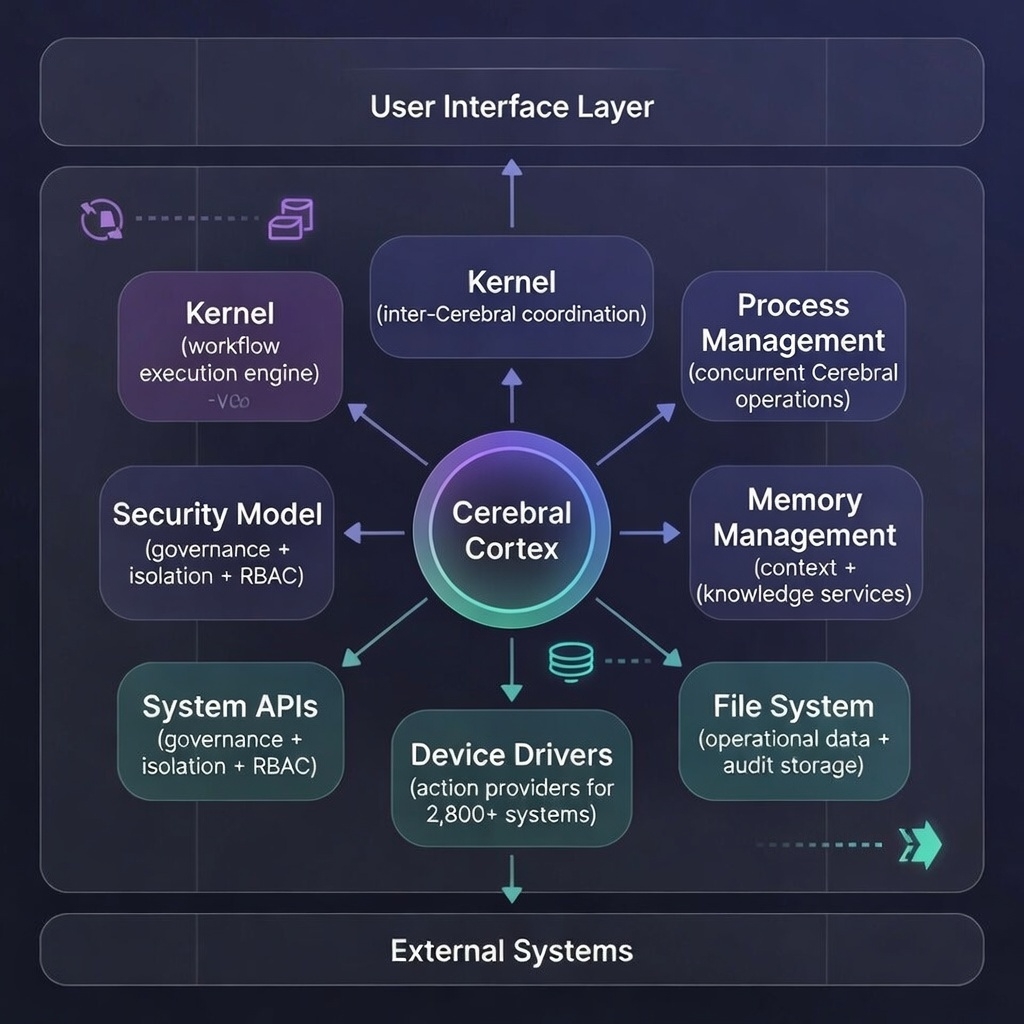
1. Kernel
The core execution engine that runs processes and manages resources.
Cerebral OS: Our skill-runner executes workflows (SOPs) with deterministic state management, error handling, and resource allocation across LLM calls and API operations.
2. Process Management
Scheduling, prioritization, and execution of multiple concurrent processes.
Cerebral OS: We manage multiple Cerebrals executing workflows simultaneously, with queue management, priority routing, and concurrency control across customer operations.
3. Memory Management
Allocation, tracking, and garbage collection of system memory.
Cerebral OS: Our memory service maintains conversation context, operational state, and knowledge retrieval with automatic partitioning, compression (Context River), and customer isolation.
4. File System
Organized storage and retrieval of data with permissions and access control.
Cerebral OS: We manage operational data, audit logs, workflow definitions, and customer knowledge with enterprise-grade access controls, partitioning, and governance policies.
5. Device Drivers
Abstraction layer between hardware and applications so apps don't need to know hardware specifics.
Cerebral OS: Our verb abstraction layer and action providers connect to 2,800+ external systems. Workflows call "issue_refund"—we route to Stripe, PayPal, Braintree, whatever you use. Swap providers, zero reconfiguration.
6. System APIs
Standardized interfaces for applications to request OS services.
Cerebral OS: Our verb API provides standardized operational primitives (refund, update_order, send_message, get_customer_data) that work regardless of underlying systems.
7. Security & Access Control
User permissions, process isolation, and resource protection.
Cerebral OS: Role-based access control, customer data isolation, policy-gated execution, audit trails, and governance controls with human approval workflows.
8. Inter-Process Communication
Allowing processes to share data and coordinate execution.
Cerebral OS: Cerebrals coordinate through shared memory services, workflow handoffs, and event-driven triggers across operational processes.
We have:
That's not "kind of like" an operating system.
That's literally an operating system.
Just for cognitive labor instead of silicon.
Traditional OS: Sits between hardware and applications
Cerebral OS: Sits between operational intent and execution systems
Traditional OS: Abstracts CPU, memory, storage, I/O
Cerebral OS: Abstracts payment providers, CRMs, support tools, fulfillment systems
Traditional OS: Runs software
Cerebral OS: Runs synthetic labor
Not for computers. For work.
If you don't like it, we don't care. We do.
And the domain was cheap—unlike everything else we've invested in building this.