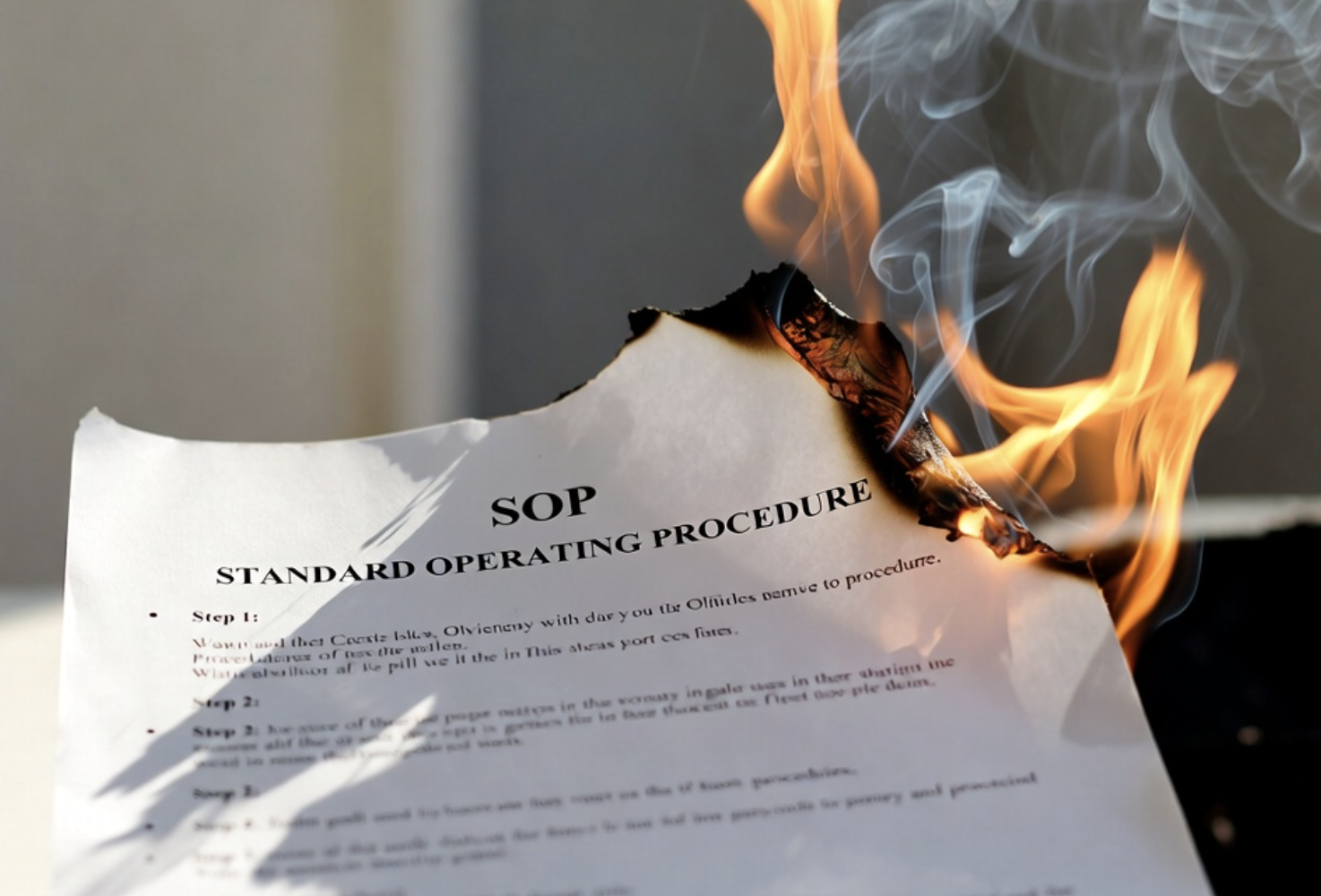
Every company has SOPs. Standard Operating Procedures that tell employees exactly how to handle customer inquiries, process orders, manage returns.
They're all designed wrong.
Not because they're bad procedures. Because they're designed around human limitations. And when you replace humans with AI employees, those limitations disappear.
The Problem With Human-Designed Workflows
Human SOPs optimize for the wrong things: speed over satisfaction (because humans get tired, minimize handle time), consistency through restriction (because humans vary, limit choices to reduce errors), efficiency over experience (because labor costs scale linearly, eliminate "unnecessary" steps), and one-size-fits-all (because you can't test what works, use best guesses).
All of this made sense when humans did the work. Now it's just leaving money on the table.
What AI Employees Change
AI employees don't have the limitations humans do. They don't get tired, so you can optimize for satisfaction instead of handle time. They execute identically, so you can actually A/B test workflows and measure what works. They don't cost more for extra steps, so you can add courtesy and personalization that humans skip. They scale without fatigue, so customer service can become a revenue center.
The A/B Testing Revolution
Here's what changes when you can test workflows: you can test greeting styles, upsell placement, explanation depth, empathy language, and offer structures.
With humans: every rep does it differently. You have no idea what actually works.
With AI: split traffic 50/50, execute identically, measure results.
After 1,000 tickets you know: casual greetings increase CSAT by 7%, upsells after resolution convert 3x better, detailed explanations reduce follow-up tickets by 23%, solution-focused language drives faster resolution acceptance, loyalty points outperform discounts for repeat customers.
You're not guessing anymore. You're measuring.
Turning Support Into Revenue
Traditional approach: customer service is a cost center. Minimize cost per interaction.
AI employee approach: customer service is a revenue opportunity. Maximize value per interaction.
Test this: 50% of order status tickets end with "Anything else I can help with?" The other 50% end with a relevant product recommendation. Run for two weeks. Measure conversion.
Actual results from a Cerebral customer: 4.2% of Variant B customers purchased the recommended product, average additional revenue was $47 per conversion, no negative impact on CSAT. Customer service went from -$8,000/month cost to +$12,000/month profit.
With humans, you can never test this systematically. With AI, it happens the same way every single time.
The Systems Design Shift
Human-centric: minimize effort, constrained by human fatigue and variance, results in simple, restrictive, one-size-fits-all.
AI-centric: maximize customer satisfaction and revenue, no constraint (AI doesn't get tired or vary), results in complex, testable, optimized through data.
Stop designing workflows around human constraints. Minimize steps → maximize value. One standard response → A/B test variations. Speed metrics → outcome metrics. Reduce complexity → add sophistication. Cost center → revenue center.
The Bottom Line
Your SOPs are designed around fatigue, variance, linear cost scaling, and inability to test systematically. AI employees don't have any of these constraints. So your SOPs shouldn't either.
You're not just automating human work. You're redesigning workflows around capabilities humans never had.
That's the difference between "AI that replaces humans" and "AI that transforms operations." Most companies are doing the first. The winners will do the second.